02 / 06 Robotics · Fusion 360

3-DOF C-Arm Robotic
System for Medical
Scanning Simulation

Overview

Background &
Objective

A C-arm robot is a highly precise mechanical system designed to position and orient an imaging device in three-dimensional space. The system derives its name from its compact C-shaped frame, which allows for wide angular coverage around a target object. Traditionally utilized in medical environments, this robotic architecture is designed to capture X-ray images from multiple angles during surgeries, enabling doctors to visualize internal structures without requiring large, invasive incisions. While full six-degree-of-freedom robots exist, implementing a focused 3-Degree-of-Freedom (3-DOF) configuration offers significant advantages, including lower costs, reduced mechanical complexity, and improved overall reliability.

The primary objective of this project is to design, develop, and build a functional prototype of a 3-DOF C-Arm robotic system that accurately performs the precise linear and rotary movements necessary for scanning applications. By replicating the complex motion and functionality of professional Medical C-Arm imaging systems , this project aims to capture a sequence of images from varying angles around a subject and seamlessly combine them into a single, comprehensive view using image stitching techniques. To achieve this, the design heavily focuses on ensuring smooth, repeatable motion, structural stability, and accurate positioning. Furthermore, the project involves developing an automated control system powered by a microcontroller, such as a Raspberry Pi, to govern the scanning process. Ultimately, this work seeks to deliver a functional prototype that serves as a robust foundation for more advanced robotic imaging platforms, thereby contributing to enhanced diagnostic accuracy and minimally invasive surgical assistance.

The development of this C-Arm robot began with meticulous 3D modeling in Fusion 360 to ensure a physically accurate and highly functional prototype. I started by taking precise dimensions of the selected stepper and servo motors, translating those real world constraints directly into the digital workspace to prevent alignment issues. Driven by rigorous structural and kinematic calculations, I and my team custom-designed the individual frame parts and the manipulator assembly to guarantee seamless hardware integration, robust mechanical stability, and precise positioning across all three degrees of freedom during the scanning process.

  • Year2026
  • RoleTeam of 5 · Kinematics & Control
  • HardwareRaspberry Pi · Stepper & Servo Motors
  • SimulationFusion 360 · D-H Parameters
  • Output2D Stitched Scan Image
  • GuideDr. Murlidhara, HOD Robotics & AI
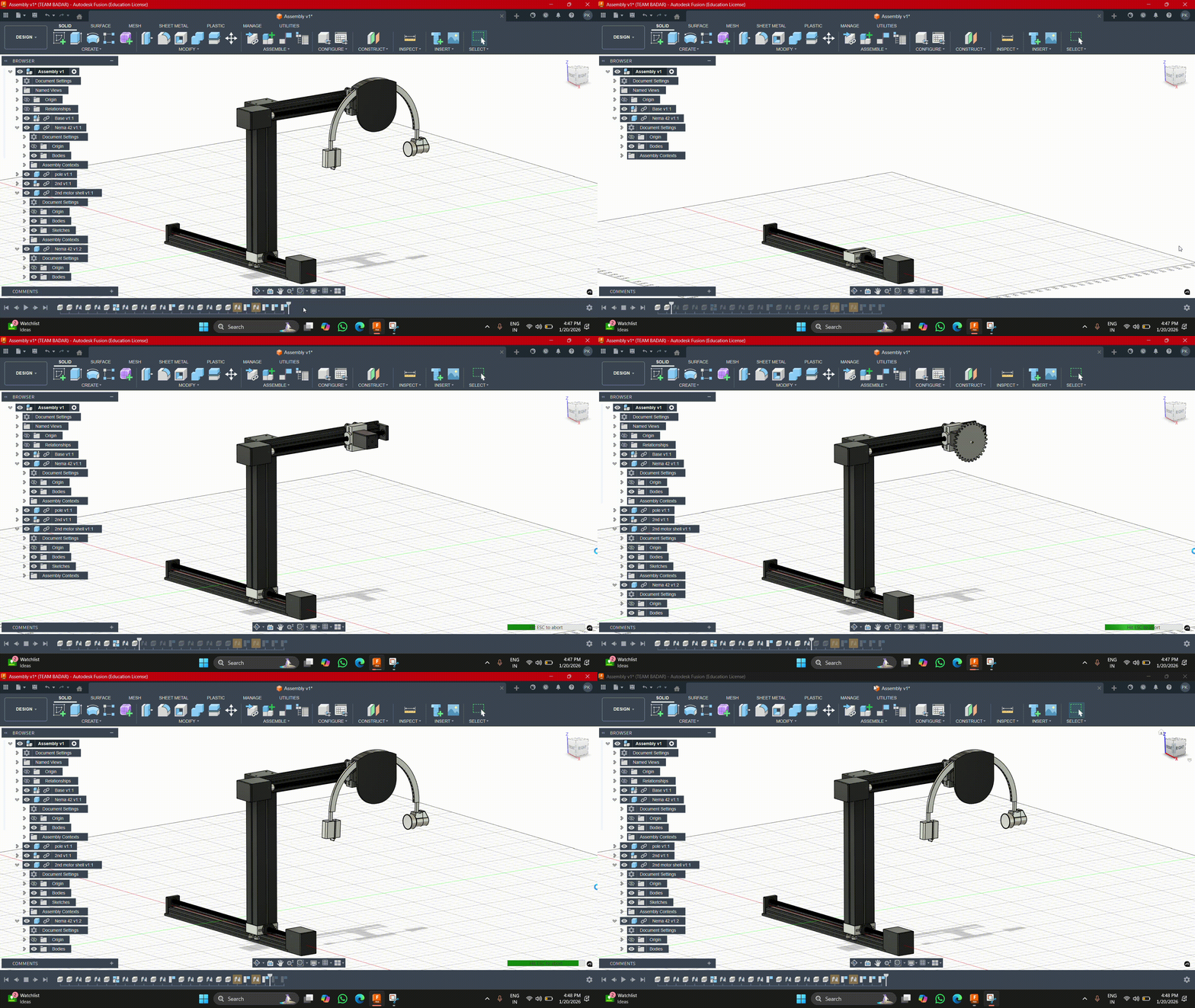
3-DOF C-Arm Robotic System
3-DOF
Degrees of Freedom
1L+2R
Joint Configuration
4links
D-H Parameter Links
360°
Scan Coverage
Process

How it
was built

01
Problem
Medical C-arm imaging systems are expensive and mechanically complex. The challenge was to design a low-cost 3-DOF prototype that replicates the rotational and translational scan motion needed for multi-angle imaging — without full 6-DOF complexity.
02
Approach
Designed a 1 linear + 2 rotary joint configuration modelled using D-H parameters. Forward and inverse kinematics were derived analytically. A Raspberry Pi handles motion planning; stepper and servo motors execute precise angular and linear displacement.
03
Results
The prototype successfully simulated C-arm scanning motion across multiple angles. Captured data at each scan position was combined into a 2D projection image via image stitching, validating the kinematic model and control system accuracy.
System Design

System
Architecture

The system architecture operates through a structured pipeline that begins with the user defining specific scan parameters, such as the angle count, step size, and scan range. These inputs are processed by a Raspberry Pi microcontroller, which handles the necessary kinematic computations by applying D-H forward and inverse kinematics to calculate precise movement trajectories.

The hardware execution is managed by a three-joint mechanism. Joint 1 governs linear motion utilizing a stepper motor to position the entire arm forward and backward. Joint 2 utilizes a servo motor to control rotary tilt, ensuring the device is perfectly aligned with the target anatomy. Joint 3 employs a second servo motor to perform a rotary sweep, rotating the arm up to 360 degrees around the object to capture multi-angle perspectives.

Throughout this sequence, a camera detector captures localized images at each step , which the system finally stitches together to generate a complete, continuous 2D scan output.

01
User Inputs Scan Parameters
Angle count · Step size · Scan range
02
Kinematic Computation
Raspberry Pi · D-H forward/inverse kinematics
03
Joint 1 — Linear Motion
Stepper motor · Forward/backward positioning
04
Joint 2 — Rotary Tilt
Servo motor · Device alignment to anatomy
05
Joint 3 — Rotary Sweep
Servo motor · 360° rotation around object
06
Image Capture & Stitching
Camera detector · 2D scan output generation
Tech Stack

Built with

Autodesk Fusion 360 Stepper Motors Servo Motors D-H Parameters Forward Kinematics Inverse Kinematics Image Stitching Python Motion Planning
Kinematic Modeling
3-DOF system modelled using Denavit-Hartenberg parameters across 4 links. Transformation matrices computed for each joint, yielding a complete 0T4 end-effector pose solution.
Joint Design
One prismatic joint handles linear Z-axis travel. Two revolute joints provide tilt and rotational sweep. The combination covers the full workspace needed for wraparound scan imaging.
Motion Control
Raspberry Pi maps user-defined scan angles and step sizes directly into motor instructions. Safety limits defined on both rotation and translation axes prevent collision or overextension.
Scan Output
Data captured at each angular position is combined using image stitching to produce a single 2D projection. Validated against reference scan patterns confirming system accuracy.
Source Code & Docs
See it
on GitHub
View on GitHub ← All Projects